jueves, 13 de junio de 2019

Verónica, our assistant teacher
Cooperative writing by Class 3C
Veronica was our assistant teacher this year. She is leaving us next June,
so our class decided to make her an interview.

Hometow (Irene) She was born in Toronto, the same city where
she lives now. When I asked her what it was like, she said that it was a nice,
beautiful and big city but that it had changed a lot over the years. She had
lived there all her life, except for a few years. She told me that she had
lived 4 years in Waterloo, 2 years in France and 1 year in Spain. She explained
to me that she hasn’t got family in Toronto anymore, but that she still has a
lot of friends there. When I asked her about her best memory of Toronto, she
answered that it was when she was 12 years old and she had been able to go from
the outskirts to the center of Toronto with total freedom.
Childhood (Gabriel) First I asked what Veronica did when she was a child and she had told me
that she liked to spend time with animals and she liked to read a lot. Then I
asked her if she went out with her friends a lot and she told me that
she hadn't had too many friends.
She had lived in a neighborhood where almost all the children were older than her so she spent time playing with her imaginary
friends.
Finally I asked if Veronica had any idols and she told me that
she hadn't.
Primary School (Alejandro) I started by asking Veronica if she
enjoyed primary school. She answered that she hadn’t liked it. She told me that it was a small school,
in that school they didn’t have a lunchroom .Also they didn’t have many
extracurricular activities. She
said that she had to ride a bus to go there, also that she had few
friends. Later I asked her what was her favourite subject and she replied
that her favourite was English
because she liked to speak it. She told me that she got along well with her teachers. Finally she said that she had
good marks in school.
Secondary School (Victor Hugo) I started the interview with Veronica
by asking what her high
school was called. She said that it was
called Runnymede Collegiate Institute.
, I asked her where it was located and she answered that it was located
20 minutes away from her house in Toronto (walking). In addition we talk about
her favourite subject. , She said that
it was English and finally I asked her
“what was your high school like ?”. , “It was fun,big but not to big,
with a pool and tennis court “ she said.
Further education (Sofía) When it was my turn, I first asked her what
she had done after she finished secondary school. She answered that first
she had started working at a summer camp for kids of all ages (from
little kids to teenagers), as a swimming
instructor. She also told me that after that summer, she had attended the
University of Waterloo for 5 years.
Finally, I ask her how she had felt at
university , and she said that it was exciting because she had freedom,
but she had been very far from home and she had also been a bit disappointed
because it hadn’t been like in the movies, it had been all very normal.
Travels (Isaac) First, I asked what countries Verónica
had traveled to, and she answered that she had traveled to countries like
Germany, Australia, New Zealand, Cuba, Mexico, US, England, France, Belgium,
Lithuania, Holland.
Later, I wanted to know what country she had liked the least and the most,
so, Verónica said that the one she liked the most was France, for the food and
the architecture, and the one that she liked the least was none.
In the end I asked her which
country she would like to travel to in the future and she exclaimed that she would
like to visit Italy.
Hobbies (Ioel) First, I asked about her hobbies and she
answered that her hobbies were reading and cooking. After that I ask
when her hobbies had started and she answered that when she was
young her classmates lived far
from her home and she entertained herself by reading books. She had
started cooking when she moved away from home. Lastly I asked Verónica If she still reads or
cooks nowadays and she told me that she reads
books and she cooks in her house whenever she has free time.
Finally she told me that
children nowadays do not read books and prefer watching TV or
playing video games and these things are less healthy than reading books. I agreed with that idea.
Interests (Enrique) First, I asked about her interests
and she answered that she liked watching films, reading books and cooking.
After that I asked her about what kind of films she liked and she said that she
liked all kinds of films except she didn't like horror films. She
also said that she would see more
documentaries but she found them very boring and when she watched TV is for
entertainment . Then, I asked her what books she liked and she said that she
liked fantasy books and fiction. .
Finally, I asked her if she liked art and she told me that she was
not very interested in art but that she liked photography a lot because
in the past she had studied photography.
Previous jobs (Sara) I started by asking what she had done
before becoming a teacher. She answered
that she had been working as a government worker.I also asked her if she had
liked that job and she said that she did, at first, but that she had gotten bored and she had
wanted to leave it.Then I asked her why
had she decided to become a teacher and she answered that she had
answered an advert to come to Spain and teach English. It was risky but
she had done it. Finally, I asked her if she liked working as a teacher and
she told me that she liked it sometimes.She didn't like it when the
students didn't listen to her.
And finally, I asked Veronica what she likes best about Palencia, and she told me that the best
thing about Palencia is that she can
ride her bicycle everywhere.
Plans (Sergio) First, I asked Veronica what were her plans
for the following year, and she answered that she would be spending the summer
in Ontario. Then, I asked her if she was planning to stay at Jorge
Manrique and she answered that she would come back in September as a language assistant for another
year. Finally, I asked her what were her plans for the future and she answered
me that she didn’t know exactly but she wanted to return to Europe and she
wanted to visit some countries like France.
domingo, 2 de junio de 2019
Europe Day
On May 9 we celebrated EUROPE DAY. The students created posters about the 28 countries in the EU and their capital cities. As well, they made up questions for a quizz. The quizz was then distributed among the students who answered it with help from the posters.


And the winning posters are:


jueves, 11 de abril de 2019
The Green Book
A Film Review by Gabriel, Pablo and Victor Hugo (Class 3C)
Our opinion is that the film was very cool because you can see the 60s
from a different point of view. And another reason why the film is so
interesting is because of the excellent acting.
|
|
THE GREEN BOOK
During the 60’s most of the people in the USA where racist so many black
people (called negroes or colored people) were discriminated against. Black
people weren’t admitted in some neighborhoods and there were also motels with
the name of colored people on them where only black people could sleep.
Characters: Tony Vallelonga, Dr Shirley, Dolores
Vallelonga. The name of the band is Don
Shirley band. In the film the protagonist (Tony Vallelonga, also called Tony
Lip ) needs a job so he works for a very famous pianist. All was going well but,
when he saw that the pianist was black, he instantly changed his mind. Finally
he accepted the job and saw that black people were also humans like them so
finally, after all the concerts, Tony invited him to share Christmas dinner
with him and his family.
 |
The reviewers
|
domingo, 7 de abril de 2019
Moving On Theatre: a play about BREXIT
BREXIT PLAY by Olivia Singh 1ºA ESO
The play is about Brexit, result of a referendum that took place in Britain two years ago, where people voted to stay or leave the EU. Sadly, 52% of the voters said Yes and 48% said No. The benefits of being part of the EU club is that you can have trade agreements and fre movement of people and goods among the states.The play tells us a sory about two people and how this event affects them. It also brings real life cases to light were people suffer from this decision, such as sacrificing the freedom of movement like going in or out of the UK. People have to spend hard earned money, time and effort in order to get the permission and British passport to stay in Britain.
The play finished with a happy ending, however the truth is yet to be seen.
lunes, 17 de diciembre de 2018
End of first term
Snowflake Workshop and letter to Santa
Our Canadian assisstant Veronica taught us how to make snowflakes. She also sent our letters to Santa and promised we would get a reply.
End of first term
domingo, 9 de diciembre de 2018
Etwinning project 1ºESO
Comenzamos el eTwinning project Lo que nos hace felices con institutos de Barletta (Italia), Ligatne (Letonia) y Romilly-sur-Seine (Francia)


domingo, 7 de octubre de 2018
martes, 26 de junio de 2018
Emily, our American assistant teacher
EMILY PIETROWSKI
Written by 4ºB students in cooperative writing
Our assistant teacher Emily is leaving us next June after teaching at our school for
two school years. We made her an interview and this is what we’ve found out about
her.
The first thing we asked her was when and where she was born. She answered that she was born on September 7, 1987. She also told us that she had 8 siblings; 1 human sibling( a sister) and a lot of dogs and cats. She was born in Seattle, Washington. She told us that she had studied Elementary school in Seattle, too. Also, she studied High school there. Her favourite subjects during secondary education were English, History and Art. As we do, they don’t study grammar in English, only literature and how to analyze it. She went to school seven hours a day, which were six periods. However, during senior year she had to stay longer because of the art classes she had. She graduated with excellent grades. As a matter of fact, her parents offered her some treats if she got lower marks because she spent most of her time studying. Then she went to university in Texas, where she studied medieval art. She has been in Palencia for two years working as an assistant teacher at our school.
It has been great to have Emily teaching us. With her, we have learned that English
is a live language that we use to communicate, instead of a series of grammar
rules that - on the other hand - not many people apply in real life. We have also had
communicative sessions in which we spoke English and had fun.

We wish her all the best in her new life back in Texas. Thank you Emily!
sábado, 2 de junio de 2018
viernes, 4 de mayo de 2018

miércoles, 18 de abril de 2018
domingo, 8 de abril de 2018
The Three R's
Vídeo realizado por 4ºB para el FESTIVAL ARTÍSTICO DE LA CIENCIA.
And the winners are...

And the winners are...

miércoles, 28 de febrero de 2018
A Trip to the SCIENCE MUSEUM
VISITING THE SCIENCE MUSEUM IN VALLADOLID
Written by 3ºA students in cooperative writing
On Thursday, February 22 2018 the Bilingual groups of
3ºESO went on a trip to Valladolid with our Science teacher Ignacio de Blas to
visit the Science Museum.
There were several remarkable exhibitions there.
 |
| Off we go! |
NUTRITION, VITAL IMPULSE
The first thing we saw was a video about food in the
different periods of history. There was a puzzle which showed the percentage of
water in some foods and in the human body. You could also smell different foods
and try to guess what each one was. Besides, there were some computers showing
the typical dishes of some countries, as well as information about the calories
and nutrients in each food. Playing with interactive games, we also learnt
about the food pyramid and the diseases we can get if we don’t have a proper
diet.


THE
TREASURES OF TUTANKHAMUN
In 1928 Howard Carter discovered the tomb of Tutankhamun
in the Valley of the Kings. This archaeologist found the pharaoh’s
personal objects by digging a hole in the wall of the burial chamber.


THE PLANETARIUM: Energy for Life
In the Planetarium, we saw an audiovisual presentation
in English about renewable and non-renewable energies and the impact they
cause. The resources have evolved from the fire mainly used in pre-history to
fossil fuels and coal used nowadays. These resources can cause a severe harm in the
environment, producing global warming and the greenhouse effect. Therefore, we
need to find new renewable energies such as wind power.


sábado, 27 de enero de 2018

lunes, 23 de octubre de 2017
Our trip to Ireland
OUR TRIP TO DUBLIN (IRELAND) (By the students in class 4ºB)
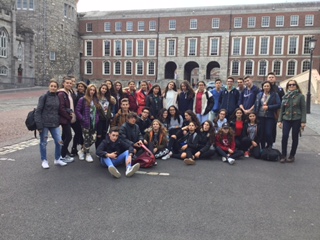
OFF WE GO! We took the bus in the roundabout behind
our school and went to Santander’s airport, which is very small if we compare
it to Madrid’s or Dublin’s ones. It was my first flight so I was nervous and
scared. Now, after flying twice, I believe it’s the safest mean of transport.
When we arrived at Dublin airport, we took a bus to the shopping center where
our host families picked us up. (Tomás Carretero)
OUR NEIGHBOURHOOD We lived in
the outskirt of Dublin. The ones who lived in the same area used to go out
together, although there weren’t many shops or people in the streets. It was
near the sea and very beautiful because of the green parks and all the nature
around. It was so exciting that a professional footballer from the national
team lived next door. (Álvaro García)

THE IRISH FAMILIES were generally friendly and
responsible but I can’t say the same about mine. We only talked to them at
dinner time, to improve our pronunciation. The main conversational topic was
how to move around in Dublin. They prepared our packed lunch and then we had
dinner with them. Our family was formed by the parents, two daughters and a
dog, which we never got to see. (Paula Antonio)
THE SCHOOL we went to in Dublin was called Apollo. The
first time there, they gave us a test to divide us into two groups. We had
classes from 9:00 to 10:30, then a break and again from 11:00 to 12:30. We had
different teachers in each class. We mainly talked about what we thought of the
past and we played games. (Daniel Morrondo)

DUBLIN is the capital of Ireland and a very large city
with a population of about 1,900,000 people. It was founded by the Vikings but
it became Ireland’s principal city following the Norman invasion. Places of interest
include the statue of Mollie Mallone and the Spike, which is an enormous needle
in O’Connell street. Irish culture is very different to ours. Their colour is
green. They also have traditional music and dancing. (Patricia Pastor)


CONCLUSION I’d recommend and repeat myself this trip
because you learn a lot about the culture and the city during the staying with
the families. They mainly teach you colloquial expressions which we don’t
usually learn in class. (Lara Mayoral)

viernes, 6 de octubre de 2017
Proyecto etwinning premiado
Muy orgullosa y contenta por el Sello de Calidad Europeo a nuestro proyecto sobre medioambiente del curso pasado en el que tomaron parte mis alumnos de 3º y 4º bilingüe en colaboración con alumnos de Italia y Grecia.
Los Sellos de Calidad etwinning los otorga las Agencias Nacionales a aquellos proyectos que acreditan una serie de valores relativos a la innovación educativa, la colaboración con otros paises europeos y el uso de las TICs.
¡Enhorabuena!

Los Sellos de Calidad etwinning los otorga las Agencias Nacionales a aquellos proyectos que acreditan una serie de valores relativos a la innovación educativa, la colaboración con otros paises europeos y el uso de las TICs.
¡Enhorabuena!

viernes, 29 de septiembre de 2017


miércoles, 27 de septiembre de 2017

Suscribirse a:
Entradas (Atom)